
Omega Balance
> Home > About Us > Blog > Omega Balance
IS YOUR OMEGA BALANCE ON POINT?
Omega-3 and omega-6 are essential fatty acids (EFA). FA are the building blocks of fat in the horse’s body, as well as the fat in the food that horses eat.
EFA’s are essential because the horse’s body can’t make them, and the body needs them – both of them.
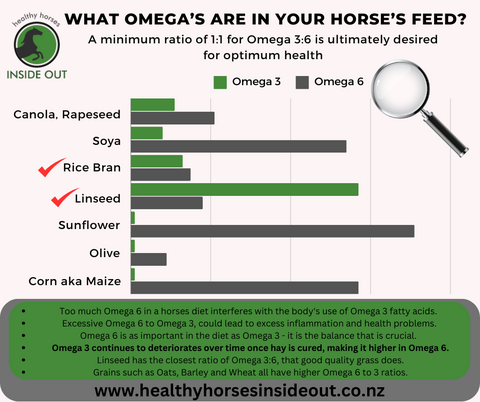
The balance between the omega-3 and omega-6 fatty acids is important, for optimum health more omega-3 than omega-6 is ideal. Omega-6s aren’t all bad and are needed, however, when omega-6 overpowers omega-3 this can create a catalyst for excessive inflammation.
Fish & Plant Based
Most important of the omega-3 family are EPA, DHA, and ALA (Alpha-linolenic acid). EPA and DHA are found almost exclusively in fish, whilst ALA is found predominantly in leafy plants and flaxseed.
Horses diets typically are top heavy in Omega 6 as these feature abundantly in their diets, more so if feeding premixed feeds and not on good quality grass.
Now, read the ingredients on your horse feed bag..
Soy, Canola aka Rapeseed, Sunflower, Maize aka Corn and Wheat all feature very predominantly. They are cheap inclusions, and they are readily available especially poly unsaturated oils and a large majority are a by-product - such as middling’s, mill run, soya hulls, canola meal, sunflower meal etc. Be careful as there may be vague ingredients like roughage product or vegetable protein usually disguising any of the above mentioned.
A large majority of horse feeds do not balance the omega ratios and are contributing to a higher omega 6, than omega 3 intake.
Hay is also higher in omega 6, as omega 3 continues to deteriorate after curing, including Vitamin E & A.
How to get a good omega balance
1) Tidy up your horses feed and eliminate high omega 6 feeds (there are more than just this reason for reducing or removing totally these feed ingredients) or feed a horse feed that has a correct omega 3 to omega 6 ratio. HINT: omega 3 should be higher than omega 6. A cup full of cheap soy, canola or vegetable oil from the supermarket is not doing your horses long term health any favours, same applies for humans.
2) If your horse is on good quality grass, just point 1 is needed.
3) If your horse is on mainly hay or little or poor quality grass, then do both point 1 + add a quality omega 3 source.
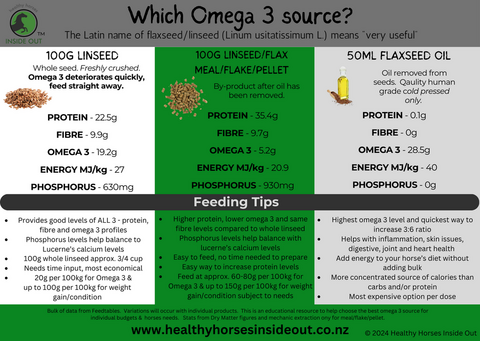
Be aware that a lot of omega oils or supplements are not higher in omega 3, than 6. Omega 6 oils are cheaper so are typically used in higher levels than the more expensive omega 3 oils. Avoid at all costs cheap linseed oil. Look for Cold Pressed Flax Seed Oil. Yes, it costs more, but a little goes a long way and daily inclusion rates are around 50ml, not 250ml. Read the labels!
Our top Omega picks
A small number of horses do not react well to Linseed, and if you have an active case of ulcers, it is suggested to stick to cold pressed flaxseed oil or temporarily remove until resolved. Chia is a good alternative for its omega 3 vs 6 balance and can be fed at double the recommended amounts of linseed. Linseed is safe for metabolic and laminitic horses, with a low starch and sugar profile and is a particularly important inclusion to a hay majority/only diet.
EFA’s are a source of energy and in oil form are a very concentrated form of calories. It also is suggested that they may help with: Energy needs, Joint movement and arthritis, skin, coat and hoof quality, reproductive health, allergy & immune conditions, exercise recovery and muscle health, eye health, endocrine, respiratory & neurological issues.
For specific serious inflammatory issues, look to an EPA & DHA source aka Fish source or a combo of Fish and Plant source.
To learn more:
Posted: Monday 2 March 2026