
Hay vs Haylage
> Home > About Us > Blog > Hay vs Haylage
HAY VS HAYLAGE? Suitable for your horse or not?
This may be late in the winter season but is an interesting read especially for those that only make haylage, with steps that you can take to make a haylage, that may be more suitable to promote optimum health in your horse's digestive system and therefore health.
There is a time and a place for everything and feeding haylage over hay, can depend on a number of things including:
- location's suitability to make hay (i.e.: lots of trees blocking full sun access - like my place)
- ability and access to buy and/or make hay in bulk & store
- The weather. A wet summer is a hay makers nightmare.
- Horses workload, weight, age, dental health and respiratory health
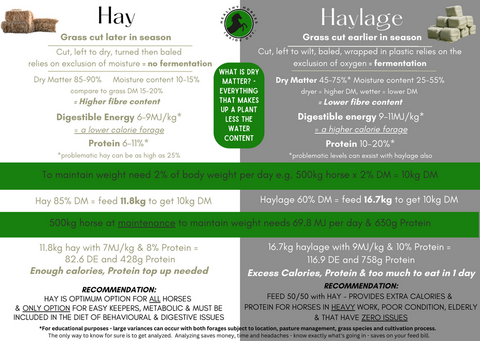
Haylage does have positives, but these positives are not suited to ALL horses. The process of fermentation that occurs in the 6-10 weeks after making haylage decreases sugars through the fermentation process BUT increases the DE (digestible energy) and CP (protein). Together with a lower dry matter (DM) content, doesn’t make it suitable for many horses. Combine that with grass that also has a low DM content along with the other common issues relating to grass growth, and you could be creating more headaches than you need.
Why is DM so important to horses? DM is quite simply the fuel for the horse. DM going through the digestive process creates fermentation microbes in the hind gut, that turn it into volatile fatty acids – said fuel. Your horse needs DM to keep those microbes working to help fuel the body, especially the digestive system which in turn fuels overall health. The higher the DM in a forage the 'less' you need to feed and more fuel for your horse. The lower the DM in a forage the more you need to feed of it. Haylage is lower in DM than Hay.
A horse needs 1.5%-3.5% of its body weight in DM depending on the individual’s needs – breeding, heavy work, poor condition, hard keeper etc. You would need to feed 11.8kg of Hay and 16.7kg of Haylage (for the purpose of this exercise hay or haylage is the only forage being consumed) to achieve 2% DM suitable for the average 500kg horse at maintenance with a good weight. Whilst haylage has lower DM, it has higher Digestible Energy (DE) and protein (CP) which is not suitable for many equines especially easy keepers, metabolic and/or laminitic prone, digestive issues such as ulcers, loose manure, and especially behavior related issues. If you have horses that would benefit from the extra protein and calories that haylage offers, it would be a good practice to do 50/50 hay and haylage, which would help to balance the DE, CP and DM intake.
If you have a horse with behavior issues who is on haylage, the first step is to look at the DM content they are consuming. If they are consuming the appropriate level of DM i.e. from the example: 16.7kg of haylage – then it’s likely the DE (too many calories) and/or too much CP is the issue. Meaning the input is more than the output. If they are not consuming the 16.7kg of haylage then you have a DM deficit. Note: if you have a particularly wet haylagy smelling haylage the water content will be far more and therefore the DM far less. This type of haylage is not suited to horses and is best kept for ruminants.
There is a growing trend to produce a drier haylage which has a higher DM than 'typical' haylage but lower DM than hay. Growing in popularity in places such as the UK is literally wrapped hay. It is not far off the DM of hay with a DM of 78-85%. Caution is needed with very dry haylage when wrapping, as dry course material may result in more air in the bale and is more difficult to wrap without puncturing the plastic. A drier haylage tends to last longer once opened versus a wet type (not suited to horses) and has less dust than hay which is suitable for horses with respiratory issues.
If you have to make haylage every year and you have no other option, there are things that you could do to help get the DM up. The DE & CP levels are subject to the time it is cut – earlier in season vs later in season, the species of grass and how soon it is baled after cutting. The only way you will know the exact levels of DM, CP & DE is to have it analyzed, which costs $90. Generally, you know around when your contractor typically comes each year, if you don’t you can get an indication of estimate. You can lock your paddocks up 4-6 weeks earlier than you usually do so that the grass is more mature when cut. For example, I know my contractor usually comes in December. So, I shut my paddocks up late September – Early October depending on how the end of winter goes and how organized I am. This works for me, my situation and location, and I get a drier haylage that is not unlike hay, just a tad moister. The plastic used for wrapping bales is not 100% airtight. Each layer of wrap reduces the porosity by about 50%. So, 6 layers of wrap will let half as much air in as 4 layers, and 8 layers will let half as much in again. Forage Plus in the UK specialize in making horse haylage for the past 10 years and aim for a DM of 70-80% and recommend at least 8 layers for the best protection and sealing.
If you have a horse that has issues on haylage then it isn’t an option for them. If haylage is the only thing you have, and not in position to buy hay - sell off some of the haylage and use that money to invest in hay.
Feed a horse like a horse and not a ruminant.
Appropriate forage is critical for many reasons, with the two most important ones being digestive tract health, and horse behavior.
Posted: Friday 23 January 2026